More information?
Please contact us:(+31) 413 38 26 33
Info@NutriControl.nl
Quality assurance as the foundation for precision feeding
“When I look at the feed side, I see that customers increasingly want to receive exactly the right nutrients, tailored to the roughage or liquid feed available on the farm. Think of a specific protein content that fits precisely within legal frameworks. It has to be correct, because too much protein intake can impact permit allowances. We must be able to rely on the measurement results – and for that, a solid laboratory is essential.”
Sustainability and the changing role of by-products
“We are actively working with CO2 certification. At the moment we still prepare annual overviews, but it’s only a matter of time before it will have to be listed on the label per delivery. For certain concepts, that’s already required. Soy, for example, has a high CO2 value due to deforestation. That makes it increasingly important to use by-products efficiently.”
“Take sugar beet pulp. It is sometimes no longer offered as animal feed because of too high emissions further down the animal chain; instead, it often goes directly to digesters. But according to Moerman’s Ladder, we should first look at applications as food or feed before using it for energy. A competition for high-quality by-products is emerging.”
Growing complexity calls for precise feed analysis
“Compound feed factories have evolved from producing standard ABC feeds to offering tailor-made solutions for each customer, and even aligned with the animal’s life stage. The more knowledge we have about the quality of raw materials, the better we can manage them. Reliable data is essential to support our decisions.”
Why AgruniekRijnvallei chose the NIRGO
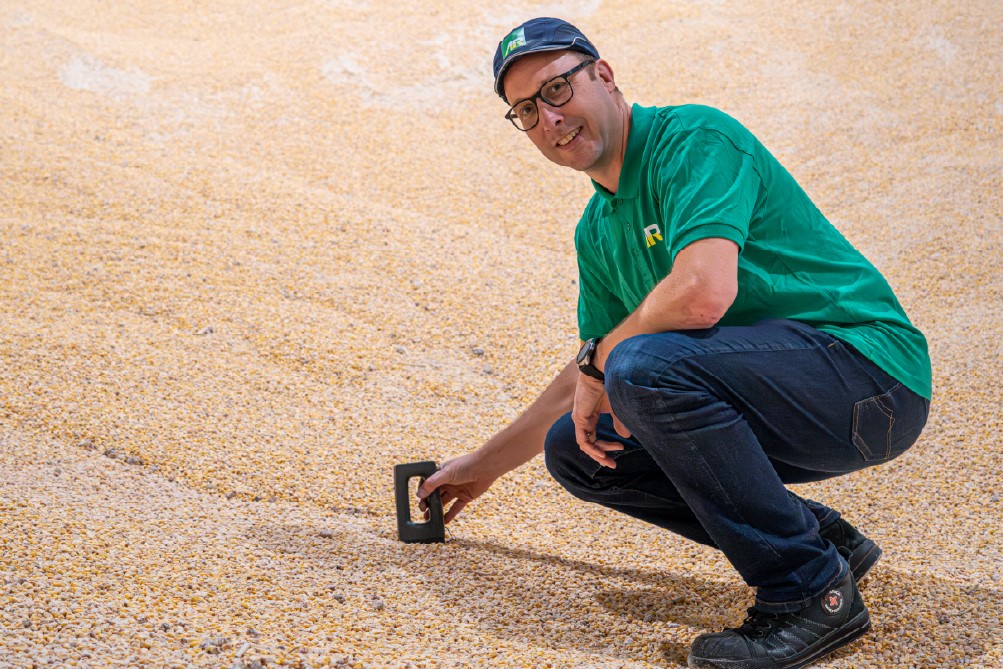
“Even at locations where only a few loads arrive, we want to be able to measure. A benchtop model is not cost-effective. The NIRGO is mobile and affordable. Now we can perform measurements anywhere and gain better insight into the nutritional value of raw materials, which can sometimes vary considerably.”