Microbiology specialist - Biochemistry
Suzanne Arts - van den Hoven
+31 413 382633info@nutricontrol.nl
Can you briefly tell what you do at NutriControl and outside NutriControl? How long have you been working for NutriControl?
My name is Suzanne Arts – van den Hoven, and I am a specialist in microbiology-biochemistry, and I have been working with great pleasure for NutriControl for over 26 years. I handle all microbiological and biochemical substantive questions and projects. I am also involved in setting up and validating new microbiological/biochemical analysis methods and maintaining these methods. I am also the biological safety officer within NutriControl, ensuring that microorganisms are handled safely and responsibly. Additionally, I am an internal auditor, where among other things, I ensure that we work according to the rules of ISO 17025. Besides my tasks within NutriControl, I am a member of the NEN committee for microbiology of the food chain and active within various ISO working groups. For the dairy microbiology working group, I fulfill the role of co-chair, together with a competitor.
Can you explain in layman's terms what MALDI-TOF is and how it works within the context of microbiological identification?
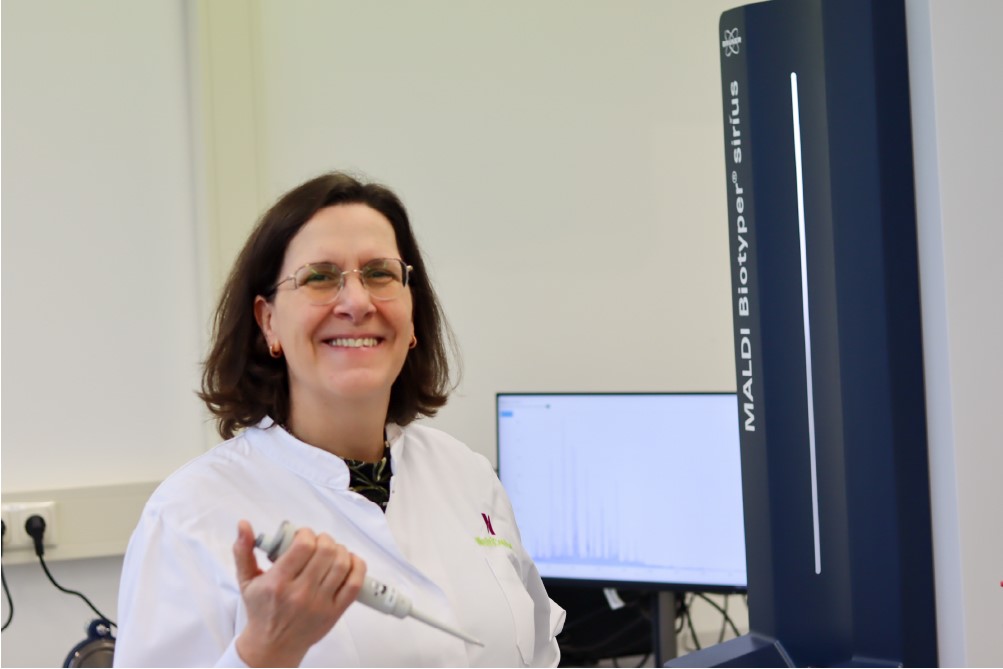
MALDI-TOF stands for Matrix-Assisted Laser Desorption/Ionization Time-Of-Flight mass spectrometry. With the help of this technology, microorganisms can be identified at the species level. For this, a colony of a microorganism to be identified is placed on a solid carrier and coated with so-called matrix material. A laser beam ionizes the matrix with the microorganism, releasing individual charged ions, which are accelerated in a flight tube and separated based on mass. These are detected by the TOF mass detector. A pattern of peaks is then obtained, which is compared to a database. Based on certain similarities, a microorganism can be identified. With the current technique, no distinction can be made between serotypes or based on the pathogenicity of microorganisms.
How does the MALDI-TOF technology change the way we support our customers with their microbiological analyses?
Due to the simplicity and speed of these methods, we can issue results days faster, actually immediately after well-isolated colonies have been obtained. Additionally, more specific guidance can be provided upon request based on the identified microorganisms.
What does the validation process of MALDI-TOF in our laboratory involve, and how do we ensure the results are reliable?
This depends on what you want to deliver. There is a difference between the identification of microorganisms, confirmation of alternative validated microbiological detection methods, and confirmation of “own” germ count and detection methods. For this, a large number of known, characterized microorganisms must be tested using MALDI-TOF, and the correspondence must be compared between these known, characterized microorganisms and the obtained MALDI-TOF result based on the database.
How can MALDI-TOF help personalize our services for the unique needs of each customer?
As I mentioned earlier, we can think along and assist upon customer request to address certain issues, for example, in the areas of house flora, contamination, source tracing, or cross-contamination.
Can our customers use the results of MALDI-TOF to improve their own production processes or quality controls?
Certainly, more insight is provided at identification regarding the type of microorganism that has been demonstrated, so specific action can be taken.